
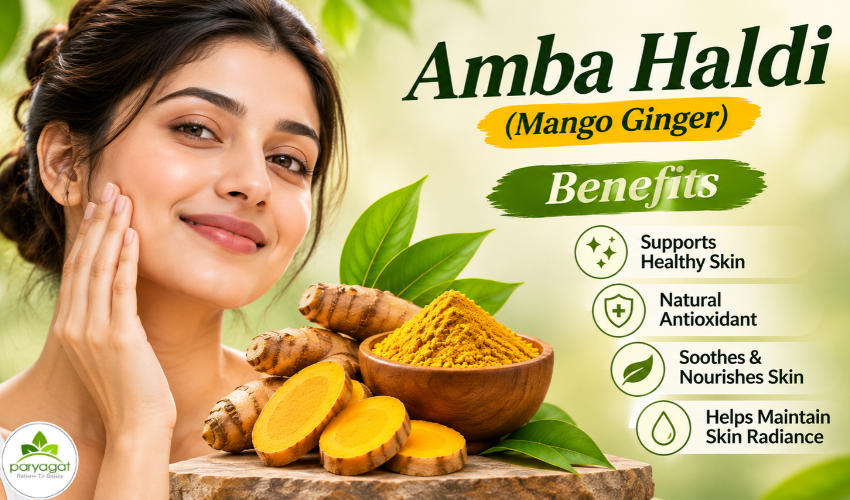
Amba Haldi Benefits for Skin Health: Ayurvedic Guide
Introduction: Discover the Traditional Skincare Goodness of Amba Haldi
Healthy-looking skin is an important part of overall personal care. From maintaining a balanced skincare routine to choosing natural ingredients, many people are exploring traditional herbal ingredients that have been valued for generations.
One such ingredient is Amba Haldi, also known as Mango Ginger. Scientifically identified as Curcuma amada, this aromatic rhizome belongs to the ginger family and is traditionally valued in Indian wellness practices.
Unlike ordinary turmeric, Amba Haldi has a distinctive raw mango-like aroma and flavour. It has a long history of use in traditional Indian preparations, including certain external skincare applications.
One particularly interesting area of research is its potential relationship with skin wellness. Amba Haldi contains naturally occurring plant compounds that have attracted scientific interest because of their antioxidant and other biological properties.
At Paryagat – Return To Basics, we appreciate the connection between traditional herbal knowledge and modern wellness research.
In this article, we explore one specific topic in detail: the potential role of Amba Haldi in supporting skin health. We will discuss its traditional skincare applications, plant compounds, scientific findings, limitations, and precautions.
Important: Traditional uses and laboratory findings do not establish that Amba Haldi treats skin conditions or improves skin in humans. More human clinical research is required.
1. What Is Amba Haldi?
Amba Haldi (Curcuma amada Roxb.) is a tropical rhizome-producing plant belonging to the Zingiberaceae family, which also includes ginger and turmeric.
It is commonly known as:
- Mango Ginger
- Amba Haldi
- Ambe Haldi
- Manga Manjal
The name Mango Ginger comes from its characteristic raw mango-like aroma, although the plant resembles ginger in appearance.
In traditional Indian practices, Amba Haldi has been valued for different purposes, including culinary preparations and external herbal applications.
Its rhizome contains naturally occurring phytochemicals, including aromatic compounds and other plant constituents. Researchers have investigated these compounds for their antioxidant, antimicrobial, and anti-inflammatory properties.
These properties make Amba Haldi an interesting ingredient for scientific investigation, particularly in relation to skin wellness.
2. How Amba Haldi May Support Skin Wellness
One of the most interesting areas of research surrounding Amba Haldi is its potential antioxidant activity.
Everyday environmental factors, including exposure to sunlight and pollution, can contribute to oxidative stress in the skin. Oxidative stress occurs when unstable molecules called free radicals accumulate and affect normal cellular processes.
The body has its own antioxidant defence systems, while a balanced diet provides additional antioxidant compounds from different foods.
Amba Haldi contains naturally occurring phytochemicals that have demonstrated antioxidant activity in laboratory research.
Understanding the antioxidant connection
Antioxidants are compounds that help counter oxidative processes. They are found naturally in many fruits, vegetables, herbs, and spices.
Researchers have investigated extracts from Curcuma amada for their ability to neutralise certain free radicals in laboratory testing.
This is scientifically interesting because oxidative stress is one of several factors associated with skin ageing and environmental skin damage.
However, there is an important distinction: antioxidant activity demonstrated in a laboratory does not automatically mean that consuming or applying Amba Haldi produces the same effect in human skin.
Why is this relevant to skin health?
Skin health depends on several interconnected factors, including:
- A healthy skin barrier.
- Adequate hydration.
- Balanced nutrition.
- Protection from excessive sunlight.
- Appropriate skincare habits.
- Overall health and lifestyle.
Plant-derived antioxidant compounds are an interesting subject of research, but Amba Haldi should be considered a traditional herbal ingredient rather than a proven skin treatment.
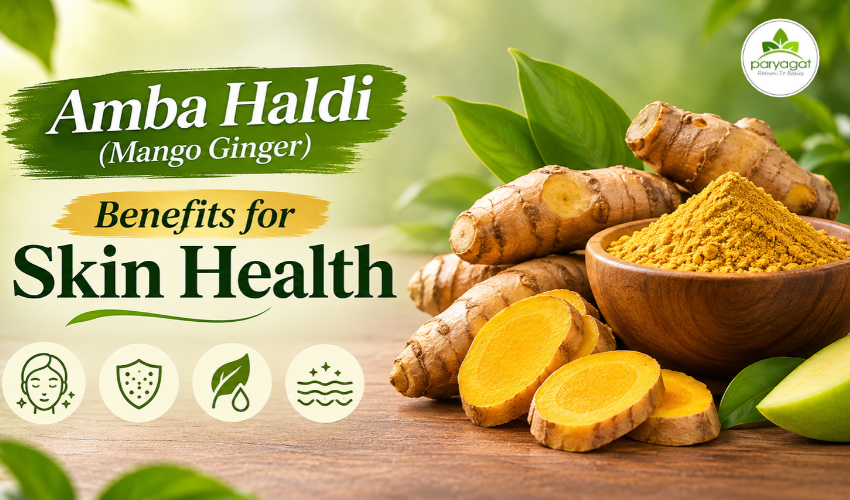
3. Naturally Occurring Plant Compounds in Amba Haldi
The rhizome of Amba Haldi contains different naturally occurring compounds that contribute to its distinctive aroma and biological characteristics.
Researchers have identified several phytochemicals in its extracts and essential oil.
A. Aromatic compounds
Amba Haldi contains aromatic constituents that contribute to its characteristic mango-like fragrance.
These compounds are part of what makes Mango Ginger different from ordinary turmeric.
B. Phenolic compounds
Phenolic compounds are naturally occurring plant substances studied for their antioxidant properties.
Laboratory investigations of Amba Haldi extracts have identified phenolic constituents and explored their antioxidant potential.
C. Flavonoids and other phytochemicals
Different plant extracts may contain flavonoids, terpenoids, and other phytochemicals.
Their concentrations can vary depending on the plant material, extraction process, and growing conditions.
It is important not to assume that every Amba Haldi powder contains the same concentration or composition of these compounds.
4. Traditional Skincare Uses of Amba Haldi
Amba Haldi has a history of use in traditional Indian skincare practices.
Different communities have incorporated herbal rhizomes into traditional external preparations. However, traditional practices vary, and they should not automatically be considered clinically proven skincare treatments.
Traditional herbal preparations
Amba Haldi has been traditionally associated with external applications for certain skin-related concerns.
Modern researchers have also investigated its extracts for biological activities, including antioxidant and antimicrobial properties.
A 2020 research study examined bioactive constituents of Amba Haldi rhizomes and investigated the antifungal activity of its essential oil against selected skin-associated fungal organisms in laboratory conditions.
This is an interesting research direction, but laboratory antifungal activity does not establish that ordinary Amba Haldi powder can treat fungal infections in people.
Natural skincare and informed choices
People interested in traditional herbal skincare should remember that natural ingredients can still cause irritation or allergic reactions.
A product intended for consumption should not automatically be used as a face mask or topical skincare preparation.
Choose skincare products specifically formulated for external use and consult a qualified dermatologist if you have persistent skin concerns.
5. Scientific Research: What Do We Know About Amba Haldi and Skin?
Scientific research into Amba Haldi is developing, and it is important to understand what current studies actually demonstrate.
Research on antioxidant activity
Studies investigating Curcuma amada extracts have identified naturally occurring phytochemicals and evaluated their antioxidant properties.
These findings help researchers understand the plant’s chemical composition and possible biological activities.
However, many findings come from laboratory experiments rather than controlled human clinical trials.
Research on antimicrobial activity
A 2020 study published in the Journal of Herbal Medicine investigated bioactive constituents of Amba Haldi rhizomes and the antifungal activity of its essential oil against selected skin-associated fungal organisms.
The findings provide an area for further scientific investigation, but they do not establish the effectiveness or safety of Amba Haldi powder as a treatment for human skin infections.
What about human clinical studies?
Research on other Curcuma species, especially ordinary turmeric (Curcuma longa) and curcumin, has investigated different dermatological applications.
However, results from ordinary turmeric cannot simply be transferred to Mango Ginger.
More research specifically involving Amba Haldi, standardised preparations, appropriate safety testing, and human clinical trials is needed before making definite skin-health claims.
The scientific takeaway: Amba Haldi has interesting traditional uses and preliminary laboratory findings, but its effectiveness for improving human skin health has not yet been established.
6. Everyday Habits That Help Maintain Healthy-Looking Skin
Although Amba Haldi is an interesting traditional ingredient, healthy skin depends on much more than one herb.
Here are some useful everyday habits:
Maintain a balanced diet
Include a variety of fruits, vegetables, whole grains, nuts, and other nutritious foods in your meals.
A varied diet provides nutrients that contribute to normal skin function.
Stay hydrated
Drink adequate water throughout the day according to your individual needs and activity level.
Protect your skin from sunlight
Excessive ultraviolet exposure can contribute to premature skin ageing and skin damage. Use appropriate sun protection, including sunscreen, protective clothing, and shade.
Follow a gentle skincare routine
Choose products suitable for your skin type. Avoid harsh products and excessive exfoliation.
Prioritise adequate sleep
A consistent sleep routine supports overall health and normal skin maintenance.
These everyday practices have a more established role in general skin care than relying on an individual herbal ingredient.
7. Precautions When Exploring Amba Haldi
Natural does not always mean suitable for everyone.
Before exploring Amba Haldi products, consider the following:
- Check the ingredient list and botanical identity.
- Purchase products from transparent, quality-conscious manufacturers.
- Follow the product’s intended-use instructions.
- Do not apply food-grade powder directly to the face without appropriate guidance.
- Stop using a product if you experience irritation or an allergic reaction.
- Consult a qualified healthcare professional if you have an existing skin condition or take medication.
- Do not replace prescribed skincare treatments with herbal products.
If you experience persistent acne, rashes, itching, unusual pigmentation, or other skin concerns, consult a dermatologist rather than relying on herbal remedies alone.
Why Choose Paryagat – Return To Basics?
At Paryagat – Return To Basics, we appreciate India’s rich heritage of traditional herbs and natural ingredients.
Our approach focuses on responsible herbal wellness, ingredient awareness, and informed product choices.
We believe customers should understand what they are purchasing and how traditional ingredients fit into a balanced lifestyle.
When exploring Amba Haldi, look for:
- Clear ingredient information.
- Transparent product labelling.
- Appropriate quality and safety information.
- Responsible product claims.
- Clear instructions for intended use.
Our goal is to celebrate traditional knowledge while encouraging modern, informed wellness choices.
8. Common Myths About Amba Haldi for Skin Health
Myth 1: Amba Haldi guarantees glowing skin
Truth: There is no strong human clinical evidence that Amba Haldi guarantees glowing or brighter skin. Skin appearance depends on several factors, including genetics, skincare habits, nutrition, and sun exposure.
Myth 2: Amba Haldi removes all skin problems
Truth: Amba Haldi is not a proven treatment for acne, pigmentation, eczema, fungal infections, or other skin conditions.
Myth 3: All turmeric varieties offer identical benefits
Truth: Amba Haldi (Curcuma amada) and ordinary turmeric (Curcuma longa) are different plants with different chemical compositions.
Myth 4: Natural ingredients cannot irritate the skin
Truth: Herbal ingredients can cause irritation or allergic reactions. Natural origin does not guarantee suitability for every skin type.
Myth 5: More Amba Haldi means better skin results
Truth: There is no established dose of Amba Haldi for improving skin health. Using more of an herbal ingredient does not guarantee better results.
9. Frequently Asked Questions About Amba Haldi and Skin Health
1. Is Amba Haldi good for skin health?
Amba Haldi has traditional skincare associations and contains naturally occurring phytochemicals that have demonstrated interesting biological activities in laboratory studies. However, its effectiveness for improving human skin health has not been established.
2. Does Amba Haldi contain antioxidants?
Research on Amba Haldi extracts has identified phytochemicals and investigated their antioxidant activity. The exact composition depends on the plant material and preparation.
3. Is Amba Haldi the same as ordinary turmeric?
No. Amba Haldi is Curcuma amada, commonly known as Mango Ginger. Ordinary turmeric is Curcuma longa. They belong to the same botanical family but are different species.
4. Can Amba Haldi improve skin glow?
There is insufficient human clinical evidence to establish that Amba Haldi improves skin glow. Healthy-looking skin is supported by balanced nutrition, appropriate skincare, hydration, and sun protection.
5. Can Amba Haldi be applied directly to the face?
Food-grade Amba Haldi powder is not automatically suitable for topical application. It may cause irritation or allergic reactions. Choose products specifically formulated for external use and seek professional advice if uncertain.
6. Does Amba Haldi help with skin pigmentation?
There is currently insufficient clinical evidence to establish that Amba Haldi treats pigmentation or dark spots. Persistent pigmentation concerns should be assessed by a dermatologist.
7. What makes Amba Haldi different from Mango Ginger?
Mango Ginger is simply another common name for Amba Haldi. Both refer to Curcuma amada, which is known for its characteristic raw mango-like aroma.
8. Can Amba Haldi replace regular skincare products?
No. Amba Haldi should not replace a suitable skincare routine, sunscreen, or dermatologist-recommended treatment.
Conclusion: Explore the Natural Heritage of Amba Haldi
Amba Haldi is an interesting traditional Indian herb with a distinctive botanical identity and a long history of use.
Its naturally occurring phytochemicals and preliminary antioxidant and antimicrobial research make it a valuable subject for further scientific investigation, particularly in relation to skin wellness.
However, traditional use and laboratory findings are not the same as proven benefits in humans. More clinical research is needed to understand whether Amba Haldi can provide measurable improvements in skin health.
At Paryagat – Return To Basics, we celebrate the knowledge of traditional herbs while encouraging responsible, evidence-aware wellness choices.
Discover the heritage of Amba Haldi and explore nature-inspired wellness with Paryagat.
Return to Basics. Choose Informed Wellness.
Add comment
You must be logged in to post a comment.